When Your Company Stock Becomes Your Whole Portfolio
A Case Study in RSU Concentration
By Gibran Le, CFP®, CRPC®
Meet Lindsey
Lindsey is a VP of Engineering at a large public tech company. She’s 38, married, and the primary breadwinner. Her husband stays home with their two kids. Her base salary is $300,000, and she’s got about 1,100 RSUs vesting each year. At recent prices, those RSUs add roughly $275,000 in income on top of her salary.
Here’s what happened: over the past 18 months, her company’s stock climbed from around $110 a share to $250. That’s more than a 125% run-up. Sounds great, right? But Lindsey did what a lot of tech professionals do when things are going well. She held onto her vested shares instead of selling. Now she’s looking at a position that’s way bigger than she planned.
She came to me with a simple question: “I know I should probably diversify, but I don’t want to get crushed on taxes. What should I be thinking about?”
If that sounds familiar, keep reading.
Her Situation
Let’s look at Lindsey’s numbers. These are some things to consider.
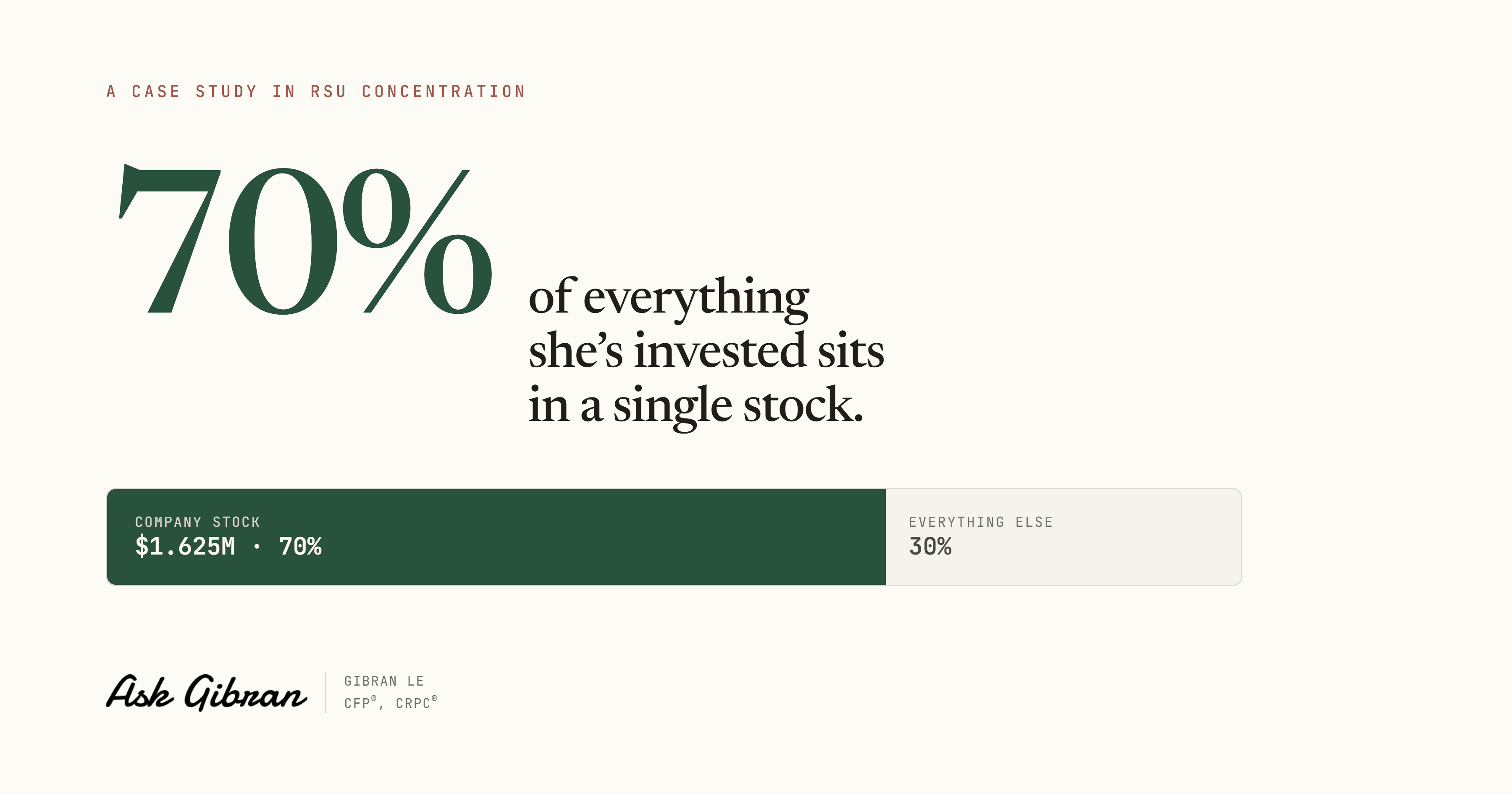
Outside of her normal RSU vests (which she sells-to-cover at vesting to handle the tax bill), Lindsey has held onto about 6,500 shares of company stock past their vesting dates. At $250 a share, that’s roughly $1.625 million in a single stock, about 70% of everything she’s got invested.
That’s a lot of eggs in one basket. But the tax picture makes it more complicated. Since RSUs vest over time, not all of Lindsey’s shares have the same cost basis. The cost basis is whatever the stock was worth on the day each batch vested. That’s what she already paid taxes on as income. Here’s what her position looks like:
Long-term shares (held over one year) — 3,800 total:
1,200 shares vested about two and a half years ago at $105/share
1,400 shares vested about two years ago at $125/share
1,200 shares vested about 14 months ago at $150/share
Because she’s held all of these for more than a year, any gains qualify for the lower long-term capital gains (LTCG) tax rates. But notice the range. Some lots have $145 per share in gains, others $100. That matters a lot when we get to the strategy.
Short-term shares (held under one year) — 2,700 total:
1,500 shares vested about nine months ago at $160/share
1,200 shares vested about five months ago at $175/share
If she sells any of these now, the gains get taxed like regular income, at her full tax rate. That’s a big difference from the long-term rates.
Adding everything up, salary plus RSU vesting income, Lindsey’s household brings in about $575,000 a year. After the $32,200 standard deduction for married couples filing jointly in 2026, her taxable income lands around $543,000. That puts her in the 35% federal tax bracket for ordinary income.
There’s also something called the Net Investment Income Tax, or NIIT. It’s an extra 3.8% tax on investment income, including capital gains, that kicks in when your income goes above $250,000 for married couples. Lindsey is well past that line, so the NIIT applies to everything she sells.
Now here’s where the long-term capital gains brackets really matter. For 2026, the IRS brackets for married filing jointly are:
LTCG Rate | Taxable Income Range (MFJ) | Total Federal Rate w/ NIIT |
|---|---|---|
0% | Up to $98,900 | 0% |
15% | $98,900 - $316,700 | 18.8% |
20% | Above $613,700 | 23.8% |
Note: The $250,000 NIIT threshold for MFJ filers is not adjusted for inflation.
Here’s the key number: Lindsey’s taxable income is already $543,000 before she sells a single share. The 15% LTCG bracket tops out at $613,700. That means she has about $70,700 of space before any long-term gains start getting taxed at 20% instead of 15%.
That sounds like decent room, but with gains this size it gets used up fast. If she sells a little, she pays 18.8% federal on the gains (15% + 3.8% NIIT). If she sells too much in one year and blows past that $613,700 line, the rate jumps to 23.8% (20% + 3.8% NIIT) on everything above it.
And that’s just the federal side. Lindsey lives in California, where capital gains are taxed the same as regular income. That could add another 9.3% or more on top.
What Lindsey Was Weighing
This is where most people get stuck.
Part of her wanted to keep holding. The stock’s been doing well. Selling feels like giving up upside. And she knew that selling would mean a real tax bill, roughly $280k in combined federal and state taxes depending on how much she let go.
But she also knew the risk. When 70% of your investments are in one stock, and it’s your employer’s stock, you’re more exposed than you think. And as the only income earner in her household, the stakes are even higher. If the stock drops 30%, it’s not just her portfolio taking a hit. It’s her equity comp, her unvested RSUs, and maybe even her job security all getting squeezed at the same time, with no second paycheck to fall back on. That’s a lot of her family’s financial life tied to one outcome.
The real question wasn’t if she should diversify. It was how to do it without paying more tax than she needed to.
The Approach
One strategy worth exploring in a situation like Lindsey’s starts with a simple question: are you still making the problem bigger? From there, it’s about selling the existing position in stages, not all at once but in planned chunks spread across multiple tax years. The idea is to stay aware of where the tax bracket lines are and try not to blow past them unnecessarily.
Here’s how that might look:
Stop adding to the pile. Before Lindsey even thinks about unwinding her existing position, the first move is the simplest one: sell her RSUs as they vest going forward instead of holding them. Every quarter, about 366 shares vest. If she sells those at vesting and redirects the after-tax proceeds into a diversified portfolio, she stops the concentration from getting worse. A lot of people skip this step because it feels small, but it’s the foundation. You can’t fix a concentration problem if you keep feeding it. And here’s the thing: there’s no extra capital gains decision to make when you sell at vest. The shares are already taxed as ordinary income at the vesting price. If you sell right away, there’s typically little to no additional gain. You’re just converting equity into cash and putting it somewhere smarter.
Start with the long-term shares, and be smart about which ones. This is where the varying cost basis really comes into play. Lindsey has $70,700 of room in the 15% LTCG bracket. With gains this large, that room gets eaten up quickly, so the key is to analyze the lots and determine how to free up the most shares with the least gain realized.
This is called specific lot identification. You tell your broker exactly which shares to sell instead of letting them pick. It’s one of the simplest ways to get more out of the same tax budget. And with a stock that’s run up this much, the gains per share are large enough that this has to be a multi-year strategy. The remaining lower-basis shares? Save those for next year’s bracket room.
Don’t rush the short-term shares. Those 2,700 shares held under a year would be taxed at her regular income rate, 35% federal plus the 3.8% NIIT. That’s 38.8% before state taxes. If she waits until they cross the one-year mark, those same gains drop to 18.8% federal. That’s a 20 percentage point difference on the exact same gain. Patience pays here.
Look for losses to offset the gains. If Lindsey has other investments that are down, selling those in the same year she sells company stock can offset some of the gains. This is sometimes called tax-loss harvesting. You’re using one loss to cancel out another gain, which lowers your overall tax bill. Be careful of wash sale rules. (I will address this in a future article.)
Think about charitable giving. If Lindsey and her husband give to charity, donating appreciated shares directly can be worth a look. She’d get a deduction at the full market value and skip the capital gains tax on those shares entirely. It’s one of the more tax-efficient ways to give.
Reinvest on purpose. The whole point of selling isn’t just to reduce risk. It’s to put that money to work in a smarter way. The goal is to stop relying on one stock for most of your financial future.
Conclusion
Holding isn’t a plan. If you haven’t actively decided to keep your shares, you haven’t really made a decision at all. You’ve just defaulted into a concentrated position. Make it intentional.
Know your bracket math. Understanding how much room you have in the 15% LTCG bracket before tipping into 20% is one of the most useful things you can figure out. It turns tax planning into something you can actually control.
The tax bill isn’t the biggest risk. The concentration is. Paying 18.8% to diversify is a whole lot easier to stomach than watching a 70% position drop 40% with no plan in place.
Each client experience is different. Past performance is not a guarantee of future results.
Want to talk through how your equity fits into your financial plan? Book a call with Gibran to discuss further.
And if you want more breakdowns like this, subscribe to the newsletter so you never miss one.