Tender Offers: You Can Sell Your Shares Before Your Company Goes Public
What They Are, How They Work, and What to Think About Before You Act
By Gibran Le, CFP®, CRPC®
What is a Tender Offer?
Most people assume the only way to turn their private company shares into cash is through an IPO or acquisition. That’s not always the case.
A tender offer is a company-managed program that lets you sell some of your vested shares before a public liquidity event. The company (or sometimes an outside buyer) offers to purchase shares at a set price, during a set window of time. You decide whether to participate and how much to sell.
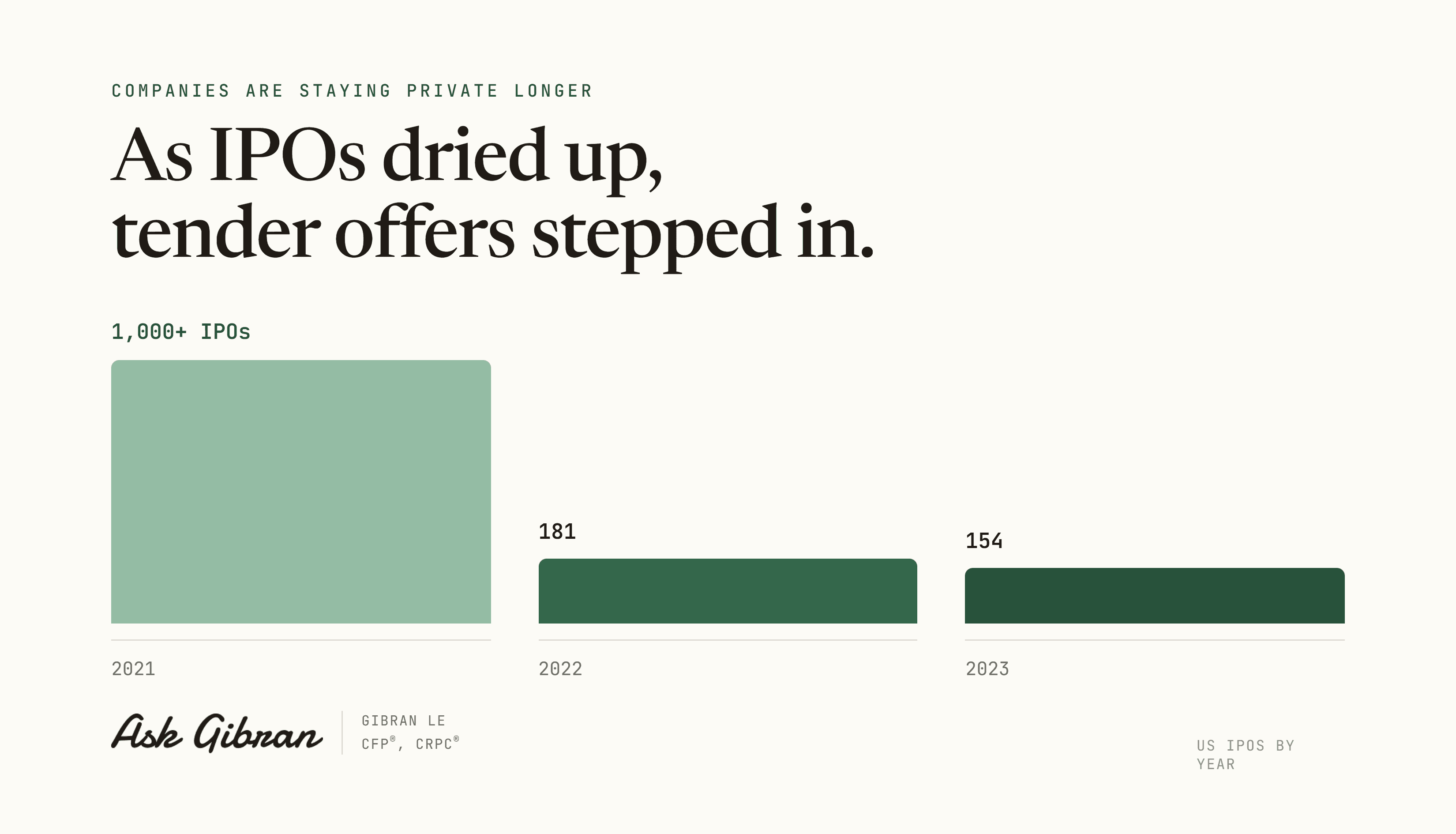
Tender offers have become much more common. In 2021, there were over 1,000 IPOs. Then things slowed down. There were 181 in 2022 and 154 in 2023. With companies staying private longer, tender offers have stepped in to fill the gap. If your company announces one, you should understand how they work and what to consider before deciding.
Understand the Rules and Limits
Tender offers come with restrictions. The more you understand upfront, the better positioned you’ll be to act during the window.
Time is limited. Tender offers are open for 20 business days, though certain changes can extend the period. Once the window closes, you can’t sell. There’s no extension just because you needed more time to think it over.
There are caps on how much you can sell. The company will set limits. It might be a dollar amount, a percentage of your shares, or a cap based on how long you’ve been with the company. These caps can vary, so read the offer documents carefully.
Here’s the thing about caps: they can actually simplify your decision. If you’re the type of person who worries, “but what if the share price takes off after the tender?”, the caps make sure you’re still holding meaningful exposure. You’re not choosing between all or nothing. You’re choosing how much of a partial exit to take.
This is where having clear goals matters. Understanding the rules lets you shift the conversation from “should I sell to make some money?” to “if I sell this amount, I can do X, Y, and Z.” That’s a much better place to make decisions from.
One more thing: tender offers may be rare. Some companies offer them regularly. Others offer them once. If this is your only window to sell before a future IPO or acquisition, that changes how you think about it. Don’t assume another one is coming.
Understand the Taxation
This is where things get more complex, and where mistakes tend to happen. The tax treatment depends on the type of equity you hold. Let me walk through each one.
Restricted Stock Units (RSUs)
If you’re at a private company, your RSUs likely have double-trigger vesting. That means two conditions have to be met before you actually own the shares. The first trigger is a time requirement. You’ve worked at the company long enough for a batch to vest. The second trigger is a liquidity event. That’s typically an IPO, acquisition, or in this case, a tender offer.
When both triggers are satisfied and you sell through the tender offer, you’ll owe ordinary income tax on the full value of the shares you redeem. The company will usually withhold taxes. But here’s what catches people off guard: the default withholding rate is often 22%. If your actual tax bracket is higher than that, and for most people reading this it probably is, you’ll owe the difference when you file your return. Plan for that gap now, not in April.
Non-Qualified Stock Options (NQSOs)
If you exercise NQSOs and sell the shares through the tender, the spread between your strike price and the tender offer price (the 409A valuation) is taxed as ordinary income. Your company will typically withhold taxes. But just like with RSUs, you need to check whether the withholding is enough to cover your actual bracket.
Incentive Stock Options (ISOs)
ISOs can receive favorable tax treatment, but only if you meet specific holding requirements. To qualify for long-term capital gains rates, you need to hold the shares for at least two years from the grant date and at least one year from the exercise date. If you’ve met both conditions, the gain between your strike price and the tender offer price is taxed at long-term capital gains rates. Those rates are significantly lower than ordinary income rates.
If you haven’t met those holding periods, it’s called a disqualifying disposition. The spread gets taxed as ordinary income, similar to NQSOs.
And if you do a cashless exercise, meaning you exercise and sell in one step, the difference between your strike price and the 409A value is taxed at ordinary income rates.
Qualified Small Business Stock (QSBS)
This is a big one, especially for early employees. If you hold shares that qualify as QSBS, you may be able to exclude a large amount of gain from federal taxes. The exclusion is up to the greater of $10 million in gain (or $15 million for stock issued after July 4, 2025) or 10 times your original investment.
The requirements are specific. The stock must have been issued when the company’s gross assets were under $50 million ($75 million for stock issued after July 4, 2025). You must also have held the shares for at least five years. Early employees who exercised options years ago are the most likely to benefit here. If you think this applies to you, verify it with a qualified tax professional before making any decisions. The potential savings are significant enough to be worth the effort.
Have a Plan in Place
A tender offer is not a time to wing it. If you sell without a plan, you’re just extracting cash. That might feel good in the moment, but it’s not a strategy.
Before the window opens, you should have clear answers to these questions:
• How much do I want to sell, and why?
• What am I doing with the proceeds? Is it going toward a specific goal like a home, diversification, or a financial cushion? Or am I just cashing out because I can?
• What is the most tax-efficient combination of shares to sell? If I hold RSUs, options, and QSBS-eligible shares, the order I sell them matters.
• Should I use some of the proceeds to exercise more options and increase my exposure for a future IPO?
• If I don’t get another chance to sell before the company goes public, will I still be on track to achieve my goals?
That last question is the one most people skip. It’s also the most important. A tender offer might be your only pre-IPO liquidity event. Knowing whether this sale moves you closer to your goals, or whether holding serves you better, is the whole point of having a plan.
The Bottom Line
Tender offers are a real opportunity. Know the rules, understand the tax consequences, and make sure the decision fits your bigger picture.
Your equity was meant to move the needle. A tender offer can help it do that.
Want to talk through how your equity fits into your financial plan?
Reach out to me at Gibran.Le@equityedgeadvisors.com.
And if you want more breakdowns like this, subscribe to the newsletter so you never miss one.
Gibran Le, CFP®, CRPC®